
Understanding of BAFF and APRIL as dual drivers of disease in IgAN has evolved1
Recent evidence now indicates that IgA Nephropathy (IgAN) is a B-cell–mediated disease in which the 2 distinct cytokines, BAFF and APRIL, play a dual role in the production of Gd-IgA1, autoantibodies, and immune complex formation and deposition.1
BAFF and APRIL represent pre-HIT 1 in IgAN1
Antigen-driven immune activation within lymphoid tissues leads to the release of BAFF and APRIL, which bind to those receptors and promote B-cell survival and production of IgA. Evidence now supports this as the earliest stage, or pre-HIT 1, in the evolving multi-hit model in IgAN.1
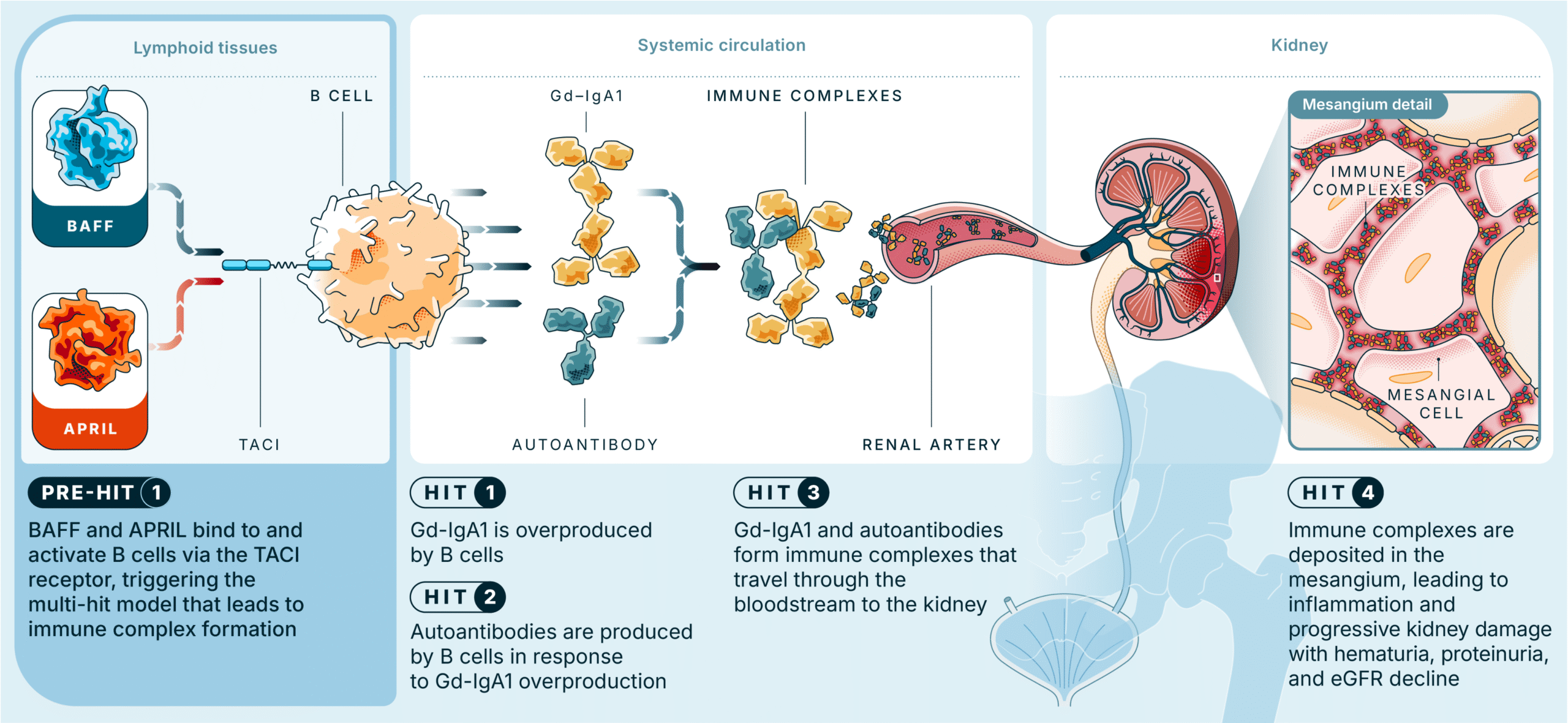
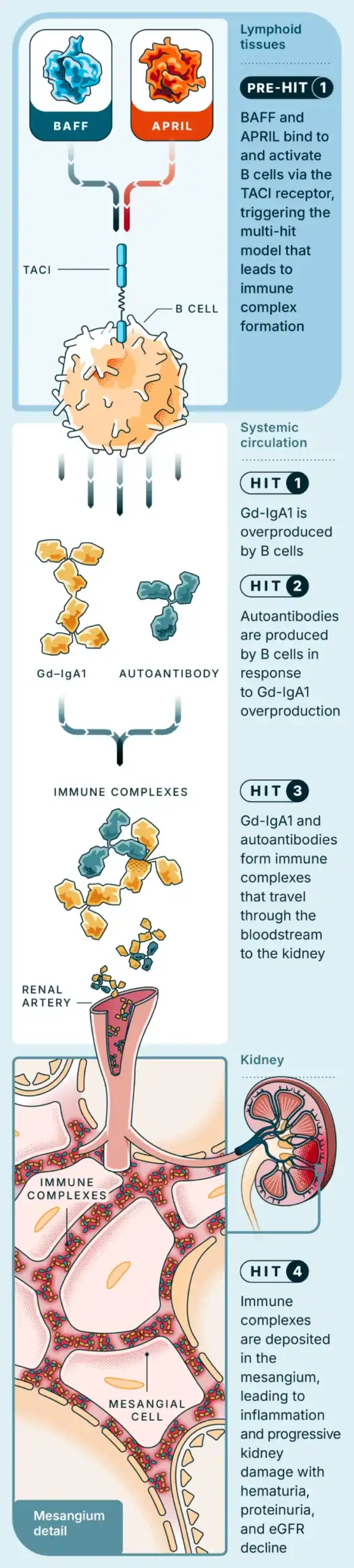
BAFF and APRIL both drive disease progression in IgAN1,2
In IgAN, the serum levels of both BAFF and APRIL—2 key cytokines associated with clinical severity—are elevated.1
Their overlapping functions suggest that their dual inhibition may effectively target upstream mediators of disease progression.1
Given that BAFF and APRIL each independently support B-cell/plasma-cell survival, dual blockade could effectively mitigate disease activity.1
All individuals in the posted videos have been compensated by Vera Therapeutics for their time.
Watch Dr Geetha discuss IgAN pathophysiology in the above video and see more expert-led videos here.
Clinical studies demonstrate that both higher BAFF and APRIL levels are independently associated with worse IgAN outcomes2-5
BAFF levels are associated with circulating IgA1 and kidney IgA deposits in patients with IgAN.{sup}2{/sup}
A study demonstrated that serum levels of BAFF were significantly higher in patients with IgAN (n=30) compared to patients with minimal glomerular abnormalities (n=30) and healthy controls (n=30). In patients with IgAN, serum levels of BAFF were positively correlated with IgA1 levels and mesangial IgA deposition density.READ NOW
Serum BAFF is elevated in patients with IgAN and is associated with adverse pathological features and reduced kidney function.{sup}3{/sup}
A study in 153 patients with IgAN, 55 healthy controls, and 20 controls with CKD found that levels of serum BAFF were significantly higher in patients with IgAN compared to controls. Higher BAFF levels were associated with clinical and pathological features of the disease, including higher levels of circulating IgA deposits in the kidney, reduced kidney function, and fibrosis and inflammation in mesangial cells.READ NOW
Plasma BAFF levels are positively correlated with the severity of pathological damage in patients with IgAN.{sup}4{/sup}
A study in 58 patients with IgAN demonstrated that plasma BAFF levels were positively correlated with renal damage (Katafuchi score). In these patients, higher pathological damage was associated with increased proteinuria, increased plasma BAFF levels, and decreased endogenous creatinine clearance rate.READ NOW
Higher APRIL levels are associated with higher serum creatinine, lower eGFR, and a worse prognosis.{sup}5{/sup}
In this study, APRIL levels in patients with IgAN (n=44) were slightly but not significantly increased compared to healthy controls (n=23), and significantly increased compared to patients with non-IgAN glomerulonephritis (n=22). APRIL levels positively correlated with serum creatinine and negatively correlated with eGFR. READ NOW
Preclinical studies show that both BAFF and APRIL have important roles in IgAN pathophysiology6-9
BAFF overexpression in mice correlates with increased IgA and markers for IgAN.{sup}6{/sup}
In an animal model, mice overexpressing BAFF developed increased levels of IgA and exhibited markers indicative of IgAN, suggesting a role for BAFF in disease pathophysiology.READ NOW
Dual blockade of BAFF and APRIL is better at inhibiting bone marrow plasma cells than blocking either cytokine alone.{sup}7{/sup}
An animal model study demonstrated that simultaneous inhibition of both BAFF and APRIL more effectively reduced bone marrow plasma cells compared to inhibition of either cytokine alone.READ NOW
Dual blockade of BAFF and APRIL decreased renal damage more than blockade of either individual pathway in an immunologic animal model, supporting the role of both BAFF and APRIL in the pathophysiology of disease.{sup}8{/sup}
In an immunologic animal model, combined inhibition of BAFF and APRIL resulted in greater reduction of renal damage than inhibition of either pathway alone, underscoring their combined role in disease development.READ NOW
Fecal microbiota transplantation from patients with severe IgAN led to increased serum BAFF and Gd-IgA1 levels in a humanized IgAN mouse model.{sup}9{/sup}
In a humanized IgAN mouse model, fecal microbiota transplantation from patients with severe IgAN caused an increase in serum BAFF and Gd-IgA1 levels, indicating a potential link between gut microbiota and disease mechanisms.READ NOW
Targeting BAFF and APRIL may modulate immune upregulation at the origin of IgAN, offering a potential chance for meaningful disease modification.1

Discover the latest peer-reviewed research and expert insights
Find publications and expert-led videos about IgAN, including the role of BAFF and APRIL and other key topics.

Elevating the standard of patient care in IgAN10,11
See the impact of recent data on IgAN treatment goals.
Test your IgAN IQ
Answer these 5 questions to test your knowledge of IgAN progression, pathophysiology, latest treatment goals, and more.
For informational purposes only and not a substitute for professional medical training or education.

Test your IgAN IQ
Question 1 of 5
Approximately what percentage of adult patients with IgAN develop kidney failure or die within 20 years of diagnosis?
Thank you for completing the IgAN quiz! You correctly answered [X]/5!
Sign up to stay informed and keep learning about the latest news and advancements in IgAN.

Keep up with the latest advancements in IgAN
Sign up to receive emails on all the latest IgAN insights, news, and research from Vera Therapeutics. These updates are intended for US healthcare professionals only.
References: 1. Cheung CK, Barratt J, Liew A, Zhang H, Tesar V, Lafayette R. The role of BAFF and APRIL in IgA nephropathy: pathogenic mechanisms and targeted therapies. Front Nephrol. 2024;3:1346769. doi:10.3389/fneph.2023.1346769 2. Li W, Peng X, Liu Y, et al. TLR9 and BAFF: their expression in patients with IgA nephropathy. Mol Med Rep. 2014;10(3):1469-1474. doi:10.3892/mmr.2014.2359 3. Xin G, Shi W, Xu LX, Su Y, Yan LJ, Li KS. Serum BAFF is elevated in patients with IgA nephropathy and associated with clinical and histopathological features. J Nephrol. 2013;26(4):683-690. doi:10.5301/jn.5000218 4. Cao Y, Lu G, Chen X, Chen X, Guo N, Li W. BAFF is involved in the pathogenesis of IgA nephropathy by activating the TRAF6/NF-κB signaling pathway in glomerular mesangial cells. Mol Med Rep. 2020;21(2):795-805. doi:10.3892/mmr.2019.10870 5. Sallustio F, Curci C, Chaoul N, et al. High levels of gut–homing immunoglobulin A+ B lymphocytes support the pathogenic role of intestinal mucosal hyperresponsiveness in immunoglobulin A nephropathy patients. Nephrol Dial Transplant. 2021;36(3):452-464. doi:10.1093/ndt/gfaa264. Erratum in: Nephrol Dial Transplant. 2021;36(9):1765. doi:10.1093/ndt/gfaa344 6. McCarthy DD, Kujawa J, Wilson C, et al. Mice overexpressing BAFF develop a commensal flora-dependent, IgA-associated nephropathy. J Clin Invest. 2011;121(10):3991-4002. doi:10.1172/JCI45563. Erratum in: J Clin Invest. 2012;122(2):778. doi:10.1172/JCI62188 7. Benson MJ, Dillon SR, Castigli E, et al. Cutting edge: the dependence of plasma cells and independence of memory B cells on BAFF and APRIL. J Immunol. 2008;180(6):3655-3659. doi:10.4049/jimmunol.180.6.3655 8. Haselmayer P, Vigolo M, Nys J, Schneider P, Hess H. A mouse model of systemic lupus erythematosus responds better to soluble TACI than to soluble BAFFR, correlating with depletion of plasma cells. Eur J Immunol. 2017;47(6):1075-1085. doi:10.1002/eji.201746934 9. Lauriero G, Abbad L, Vacca M, et al. Fecal microbiota transplantation modulates renal phenotype in the humanized mouse model of IgA nephropathy. Front Immunol. 2021;12:694787. doi:10.3389/fimmu.2021.694787 10. Floege J, Bernier-Jean A, Barratt J, Rovin B. Treatment of patients with IgA nephropathy: a call for a new paradigm. Kidney Int. 2025;107(4):640-651. doi:10.1016/j.kint.2025.01.014 11. Barratt J, Lafayette RA, Floege J. Therapy of IgA nephropathy: time for a paradigm change. Front Med (Lausanne). 2024;11:1461879. doi:10.3389/fmed.2024.1461879