
In IgAN, a B-cell–mediated
disease, 2 cytokines share
serious consequences.1

APRIL

ACTIVATION

AUTOANTIBODIES

COMPLEXES

DAMAGE
Explore the role these 2 distinct cytokines play together in IgA Nephropathy (IgAN), along with the unrecognized burden of disease and new treatment goals.1

All patients with IgAN are at risk of ESKD within their lifetime2
Supportive treatments fail to target the origin of pathophysiology in IgAN, putting patients at risk of progressive kidney damage and leading to high rates of kidney failure that result in dialysis or transplant and increased risk of early death.1,3
BAFF and APRIL both drive disease progression in IgAN1
Recent evidence now implicates upregulation of the cytokines BAFF and APRIL in activating B cells to overproduce Gd-IgA1 and autoantibodies, leading to the formation and deposition of immune complexes.

Recent evidence supports new treatment goals for IgAN1-2,5-6
Existing data supports the importance of minimizing eGFR loss to <1 mL/min/year and highlights the urgent need for disease-modifying therapies that reduce the formation of immune complexes via reductions in Gd-IgA1.
Watch expert perspectives on IgAN
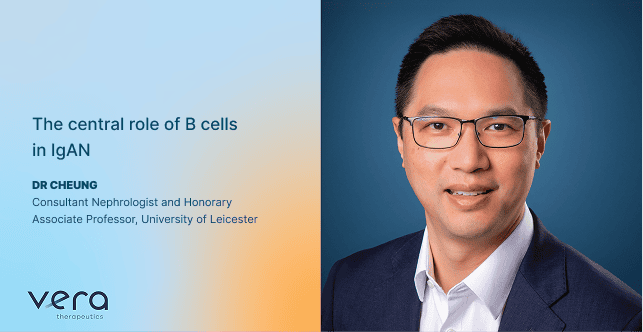
The central role of B cells in IgAN
Dr Cheung
Consultant Nephrologist and Honorary Associate Professor, University of Leicester

The central role of B cells in IgAN
Dr Geetha
Nephrologist and Professor of Clinical Medicine, Johns Hopkins University School of Medicine
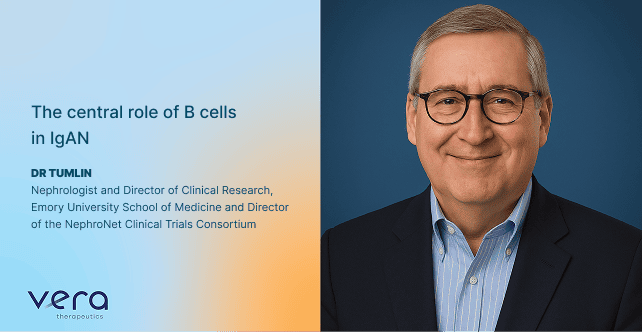
The central role of B cells in IgAN
Dr Tumlin
Nephrologist and Director of Clinical Research, Emory University School of Medicine and Director of the NephroNet Clinical Trials Consortium
All individuals in the posted videos have been compensated by Vera Therapeutics for their time.

Discover the latest peer-reviewed research and clinical tools
Find research and publications on IgAN, including the role of BAFF and APRIL.
Test your IgAN IQ
Answer these 5 questions to test your knowledge of IgAN progression, pathophysiology, latest treatment goals, and more.
For informational purposes only and not a substitute for professional medical training or education.

Test your IgAN IQ
Question 1 of 5
Approximately what percentage of adult patients with IgAN develop kidney failure or die within 20 years of diagnosis?
Thank you for completing the IgAN quiz! You correctly answered [X]/5!
Sign up to stay informed and keep learning about the latest news and advancements in IgAN.

Keep up with the latest advancements in IgAN
Sign up to receive emails on all the latest IgAN insights, news, and research from Vera Therapeutics. These updates are intended for US healthcare professionals only.
APRIL=A proliferation-inducing ligand; BAFF=B-cell activating factor; eGFR=estimated glomerular filtration rate; ESKD=end-stage kidney disease; Gd-IgA1=galactose-deficient immunoglobulin A1; IgA=immunoglobulin A.
References: 1. Cheung CK, Barratt J, Liew A, Zhang H, Tesar V, Lafayette R. The role of BAFF and APRIL in IgA nephropathy: pathogenic mechanisms and targeted therapies. Front Nephrol. 2024;3:1346769. doi:10.3389/fneph.2023.1346769 2. Pitcher D, Braddon F, Hendry B, et al. Long-term outcomes in IgA nephropathy. Clin J Am Soc Nephrol. 2023;18(6):727-738. doi:10.2215/CJN.0000000000000135 3. Kwon CS, Daniele P, Forsythe A, Ngai C. A systematic literature review of the epidemiology, health-related quality of life impact, and economic burden of immunoglobulin A nephropathy. J Health Econ Outcomes Res. 2021;8(2):36-45. doi:10.36469/001c.26129 4. Floege J, Bernier-Jean A, Barratt J, Rovin B. Treatment of patients with IgA nephropathy: a call for a new paradigm. Kidney Int. 2025;107(4):640-651. doi:10.1016/j.kint.2025.01.014 5. Barratt J, Lafayette RA, Floege J. Therapy of IgA nephropathy: time for a paradigm change. Front Med (Lausanne). 2024;11:1461879. doi:10.3389/fmed.2024.1461879